The Relentless Agressive Defense Continued to Hound the Quarterback Worksheet
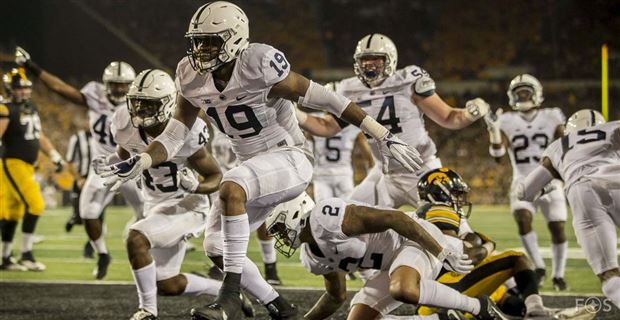
Three takeaways, pass rush stats and quick-hit thoughts from a comprehensive film study of Penn State's defense in last Saturday's 21-19 win at Iowa.
1. Unafraid of Iowa's air attack, Lions blitzed all night
As with any week, Penn State kept its scouting report on the Hawkeyes under lock and key from Monday through Friday.
Unlike most Saturdays, that report became plainly obvious after just two series. In fact, amid their play signals and calls, the Nittany Lions sideline may as well have flashed a neon sign that read: They can't throw on us.
Given its matchup advantages both on the perimeter and in the trenches, Penn State knew Iowa's wideouts would struggle to create separation against Grant Haley and Christian Campbell and the team's linemen to protect quarterback Nate Stanley from its host of young pass rushers. So the blue and white effectively turned its full attention to the Hawkeyes' offensive foundation, the running game, and blitzed and blitzed and blitzed.
In fact, Penn State blitzed from five different positions on its first six defensive snaps alone. The Lions sent cornerback, safety and all three linebackers at Stanley to unsettle him, but mostly contain Akrum Wadley over a pair of three-and-outs. Mixed in with their constant pressures, Brent Pry's group also added the occasional twist and stunt to clog running lanes.
You'll see one such twist on a blitz below, where Penn State plays what's known as "Trap coverage" behind it, a defense designed to draw out and then intercept a quick pass on an out-breaking route.
By my count, Penn State blitzed on more than 60 percent of its defensive snaps, the highest mark I've charted in the last year-plus. Every Iowa possession that lasted at least three plays saw at least two blitzes with the exception of one series early in the second half. As you'd expect, these were mostly zone pressures, though Pry effectively mixed his calls and forced Stanley to hold onto the ball for an extra second on the downs he faced only a four-man rush.
Switching back to the running game, Wadley averaged a mere 3.05 yards per carry outside of his 35-yard scamper at the end (the result of a defensive breakdown detailed below). His first 11 rushes went for a combined negative three yards, none of which traveled longer than nine feet.
And through the air, Stanley achieved a meager 5.76 yards per attempt excluding his 70-yard checkdown to Wadley, another score aided greatly by a Penn State error.
All in all, the Lions hounded and harassed their hosts. And they have their relentless game plan to thank for that.
2. Critical mistakes delivered Hawkeyes' touchdowns
The fact Iowa generated explosive plays by capitalizing on its opponent's mistakes was no surprise. Typically, the Hawkeyes pound away at a defense with their base inside and outside zone runs, plodding along until a crease opens wide enough to blaze a path to the end zone.
Iowa never found that path through attrition, but it nonetheless rode two key Penn State errors to pay dirt.
Down 15-7 on a third-and-6 play early in the fourth quarter, the Hawkeyes aligned in a 3x1 formation with three pass catchers to the wide side of the field, a single receiver to the boundary and Wadley next to Stanley in the backfield. Penn State matched with a Cover 1 pressure, meaning the Lions rushed five and played man-to-man behind them with a safety patrolling the deep middle in zone. This left six defenders to defend five potential targets.
However, at the snap Jason Cabinda rushed behind Cam Brown and around the left end, which left zero second-level defenders to cover Wadley in the event he leaked out. And that's exactly what Wadley did.
It wasn't until the shifty back had a step on Cabinda that he began to retreat in coverage and eventually crashed into an incoming Nick Scott, a collision that left only green grass between Wadley and the end zone.
From this view, the most probable explanations here are either that Cabinda and Brown miscommunicated or Cabinda prematurely committed to a "green dog" blitz (meaning he had Wadley in man-to-man, assumed Wadley would pass protect and then blitzed before bothering to read his intention). Other causess are indeed possible, but the latter explanation catches my eye because during the Hawkeyes' first touchdown Cabinda rushed late and came *this* close to stopping Stanley from delivering a go-ahead, 21-yard touchdown.
And on that play, Penn State also dropped into Cover 1.
So could Cabinda's earlier near-sack have been in the back of his mind at the snap of Iowa's second score? Perhaps. Or maybe there's another explanation entirely no one outside Penn State's building will ever become privy to.
Whatever the case may be, there's no debating the Lions similarly greased the wheels of Wadley's next score, a 35-yard rush that put Iowa ahead 19-15 with under two minutes remaining.
Again executing a Cover 1 blitz with its Will linebacker firing through the C gap (space outside the offensive tackle and between the tight end), Penn State slanted its line away from the blitzer and toward the wide side of the field. This demanded the defensive tackles to defend the gap one over to their right, a common assignment within the Lions' pressure schemes. Yet what spoiled this effort for Penn State were two things:
A) The fact that Ryan Buchholz had lined up at 1-technique, a position typically reserved for the Lions' largest and most powerful tackles except during most obvious passing downs, which this first-and-10 snap appeared to be. Consequently, Buchholz failed to win at the point of attack against left guard Ross Reynolds' run block (Buchholz later tossed Reynolds to the ground) and was turned inside, while neighboring defensive end Shaka Toney was taken out of the play. And then ...
B) No linebacker was available to clean up the mess behind him, as Cabinda had shifted closer to the soon-to-be blitzing Bowen.
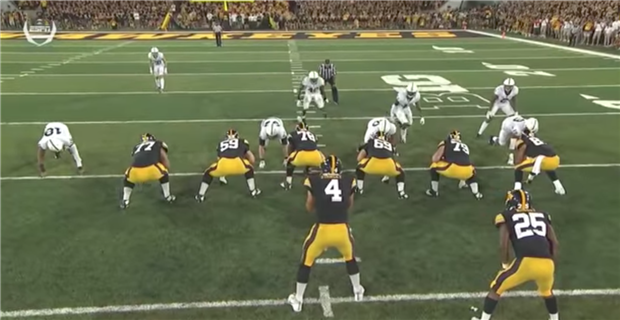
Buchholz's failure to control the B gap and Toney getting erased ultimately played the largest roles in Wadley's touchdown here, then it was Cabinda getting knocked off his longer path to the ball by center James Daniels and a poor tackling angle taken by Troy Apke, Penn State's last line of defense.
A step here or there by any of the aforementioned Lions, either pre or post-snap, and who knows where Wadley may have been stopped on the play.
Of course in that event, Iowa would then have had the opportunity to drain more clock and prevent Penn State from receiving the ball again. So in a way, the Lions' gravest errors eventually proved to be a blessing in disguise.
3. Iowa should've adjusted earlier to Penn State's aggression
The best way I could describe the Hawkeyes' offensive approach Saturday is to say they were banging their heads against a wall.
A fast, furious, suffocating wall.
Through three quarters, Iowa managed only 132 yards of offense, then began to find holes thanks to the Lions' missteps detailed above and a few play calls that punished their aggressive approach. Specifically, Wadley took two second-half draw plays for 24 yards, proof Penn State's superior team speed could act as a weakness.
It was unfortunate for the Hawkeyes that it took them until the final play of the third quarter to find such success and capitalize on what had been apparent since the early stages: Penn State was chasing any sign of a hand-off with complete and total abandon. The Lions did squash a couple screen passes, but overall flew blindly to the ball as seen below.
Facing such a strong defensive flow, Iowa ought to have turned to more draws, bootlegs, play-action rollouts, screens or other means of misdirection to create some hesitation within Penn State's defenders. There are a number of RPOs with bubble screen tags in the Hawkeyes' playbook. A couple quick tosses to the outside might've done the trick.
Yet Iowa instead continued to charge into a stout front and drop back against waves of pressure. Were these teams to play tomorrow, I guarantee you'd see a more diverse call sheet from Iowa because its same old formula was no match for a faster, remade Lions defense.
Pass-rush stats
Shareef Miller — 2 QB hits, 1 hurry
Marcus Allen — 1 sack, 1 QB hit
Kevin Givens — 1 QB hit, 1 hurry
Koa Farmer — 1 QB hit
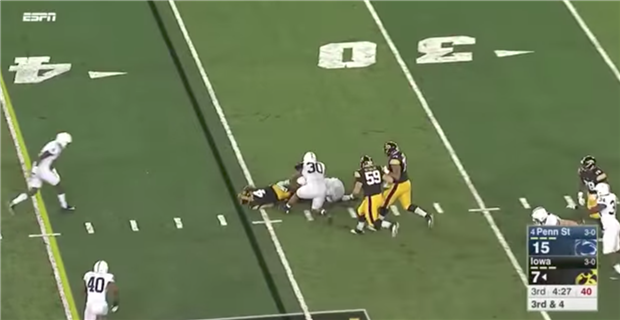
Curtis Cothran — 1 sack (unofficial sack ruled as 0-yard run and shown below)
Quick hits
- Iowa tested Penn State's defense with a Pin and Pull run on its opening play. The Pin and Pull is a change-up to their typical stretch outside zone and was notable because we've discussed how the design has given the Lions trouble in each of the last two Tale of the Tapes. The Hawkeyes ran it a few more times with middling success.
- I loved the adjustment of placing Kevin Givens at defensive end against a stronger running team. He remains Penn State's most impactful lineman on a per-snap basis, in my opinion.
- The Lions missed a few tackles but were stronger in that department compared to their first few games.
- Playing off man coverage, Troy Apke bit on a double move against Easley to allow Iowa's first touchdown at the end of the first half.
- Liked what I saw from Cabinda, Bowen and Farmer. They're all playing fast and freely.
- Next Saturday's kickoff against Indiana will be the stiffest test Haley and Campbell see all regular season.
Source: https://247sports.com/college/penn-state/Article/Penn-State-football-Tale-of-the-Tape-Defense-at-Iowa-107938790
0 Response to "The Relentless Agressive Defense Continued to Hound the Quarterback Worksheet"
Post a Comment